By Michael Jenney
I thought I was commenting on concert tickets—instead Instagram decided I was revealing my entire political philosophy. After Fox News reported that Kacey Musgraves had asked fans to support the Young Center for Immigrant Children’s Rights during the Chicago opening of her Middle of Nowhere tour, I wrote, “Damn, I bought tickets to her show in Denver. I like her music, but this and what my friends have said about her politics are making me rethink going and selling them.” Within minutes, strangers had concluded that I opposed helping children, obsessively supported Trump and MAGA, hated immigrant children, and possibly needed to examine my masculinity. The irony was that my reaction was coming from the right. I am a conservative, and I was responding as one: skeptical of celebrity activism, wary of progressive immigration politics and annoyed with entertainers using the stage to promote causes many of their fans may not share. And let’s be frank: most of the crap that comes out of their mouths is tactfully rehearsed with their PR teams. They probably couldn’t seriously debate many of the issues currently facing our country if confronted on them.
I had not mentioned Donald Trump, MAGA, immigration enforcement or opposition to helping children. I had not even definitively said I was selling my tickets. Those distinctions quickly became irrelevant. One person accused me of reconsidering the concert because Musgraves “advocates for dying kids.” Another interpreted my comment as opposition to “the humanity of children of immigrants.” Trump and MAGA soon entered the discussion, followed somehow by Kid Rock and Jeffrey Epstein, in a conversation that had begun with Kacey Musgraves tickets. What initially irritated me became a small, deeply unscientific but revealing case study in how Americans now argue: we replace what people actually say with what we assume their opinions must mean, then attack the imaginary version.
The screenshots made the pattern impossible to miss. One person stretched my sentence into a claim I had never made, the next responded to that invented claim as established fact, and someone else added another assumption and presented the entire chain as evidence of my character. By the end, I had become a fictional political villain assembled by the social media committee of morality. Political arguments seem to work this way with increasing frequency. If the writer is conservative, the blanks are filled with hostility toward immigrants, racism, indifference toward children, devotion to Trump and whatever else completes their narrative. Progressives receive their own version, with assumptions about religion, borders, police and social issues assigned automatically. Different accusations, same intellectual shortcut: instead of asking what someone means, we decide what someone like them must mean.
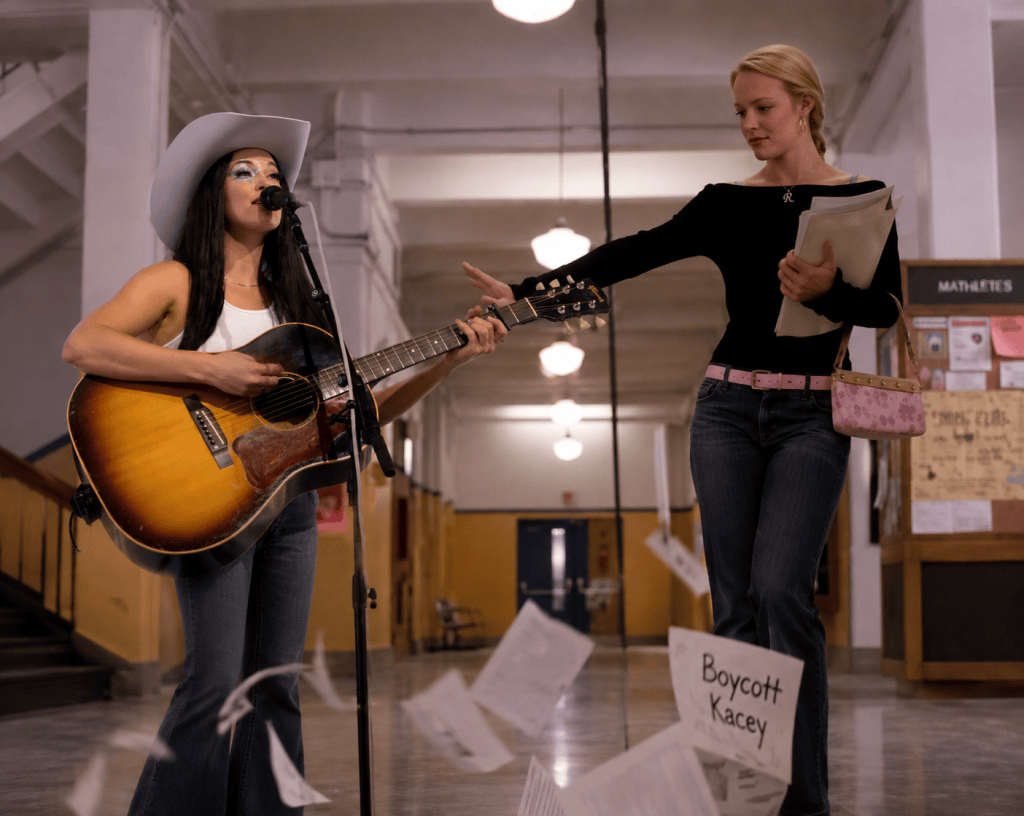
Apparently, leaving one political comment on Fox News Instagram is the digital equivalent of Regina George photocopying the Burn Book, tossing the pages through the halls of North Shore and standing back to watch the building erupt. Except Regina knew exactly what she was doing. I thought I was talking about Kacey Musgraves tickets. I dropped one comment, walked away and returned to find the metaphorical hallways in flames, with strangers debating my politics, morality and masculinity as if I had personally distributed dossiers on myself. Somewhere, Regina George would have respected the efficiency.
Before drawing my own conclusions, I wanted to know what had actually happened, because social media has a remarkable ability to turn facts into political Play-Doh. Musgraves had paused her concert and encouraged fans to support the Young Center, whose work includes advocating for immigrant children through attorneys, social workers and volunteer child advocates. The donation was optional, and her support did not begin that night. Earlier this year, pieces from her personal wardrobe were sold through Depop, with proceeds benefiting the same organization. That mattered because one criticism circulating was essentially, “She’s a multimillionaire. Why doesn’t she donate her own money?” I understand the instinct. I am skeptical when wealthy celebrities ask ordinary Americans, some of whom may have saved for months to afford concert tickets, to reach into their wallets for another cause. But intellectual consistency requires acknowledging evidence when it complicates your preferred argument. Musgraves had contributed her own resources, and pretending otherwise simply because it makes the conservative rebuttal cleaner would be dishonest and predictable.
That does not mean everyone should donate, nor does it place her characterization of deportations as “unfair” beyond criticism. It means two things can be true simultaneously, a concept social media appears determined to eradicate. A celebrity can sincerely care about immigrant children while still being criticized for the politics surrounding her message. A conservative can support immigration enforcement while believing children caught in immigration disputes deserve humane treatment. Laws and borders do actually matter. Children are not political abstractions, and it’s wildly unfair to treat them as such.
The same complexity applies to celebrity activism. I do not believe musicians become public-policy experts because they have a microphone, millions of followers, millions of dollars and a team capable of making them look excellent under difficult lighting. I also do not believe entertainers surrender their citizenship when they walk onto a stage. Musgraves has every right to support the Young Center, discuss immigration and ask fans to donate, just as I have every right to find it irritating, disagree with her politics and decide whether I want to spend money on the experience. Her right to speak does not require my applause, and my right to criticize does not require her silence. Choosing not to buy a ticket is not censorship, speaking from a stage is not persecution, and attending despite disagreement is not political surrender.
I am also not pretending my original comment was perfectly phrased. It was quick and provocative, and I knew mentioning a popular musician’s politics in a Fox News comment section was not exactly the digital equivalent of releasing a butterfly into the sky. If someone says a charitable appeal made him reconsider attending a concert, it is reasonable to ask whether he objects to the charity, the politics, the venue or the celebrity’s involvement. What is not reasonable is answering that question for him and condemning him for the answer you invented. Yet once commenters had decided what I believed, clarification became suspicious. Explaining that I was skeptical of celebrity activism rather than opposed to helping children looked like backtracking. Acknowledging Musgraves’s own contribution looked like an attempt to appear reasonable.
Just like I knew it would, things eventually became personal. I was told to get a life, seek help and examine my values, none of which addressed immigration, the Young Center or celebrity activism. I would love to claim moral superiority, but I have participated in versions of the same behavior. I have responded sarcastically when a serious answer would have been better, assumed motives and chosen the least charitable interpretation because it was easier than considering what someone might actually mean. Receiving that treatment from hundreds of strangers has a funny way of exposing how ridiculous political mind-reading looks from the other side.
As a gay conservative, political mind-reading is particularly familiar territory. For some Americans, the words “gay” and “conservative” appearing in the same sentence seem to truly puzzle the mind. There remains an assumption that sexuality should arrive bundled with predetermined opinions about immigration, guns, abortion, religion, taxation, foreign policy and whichever controversy has conquered social media that afternoon. Being gay does not give my conservative opinions special authority, and being conservative does not make me an ambassador for every Republican politician or position. Some people cannot imagine a gay man being conservative without assuming he is confused, manipulated or secretly ashamed. Others assume that because I am gay, I should automatically support every progressive position associated with identity or social justice.
I can support one conservative argument and reject another. I can believe immigration laws should be enforced while believing children affected by those laws deserve compassion. None of that should be revolutionary, yet our political culture treats nuance as though someone forgot to select a team. Conservatives who criticize conservative politicians are accused of betrayal, liberals who question radical policies are accused of helping the enemy, and voters who change their minds after learning new information are accused of weakness. We claim to value independent thought while often rewarding tribal loyalty instead. Can’t we all just agree to disagree and live our lives? I don’t care who you vote for, who you sleep with, where you’re from or the color of your skin. Just be a good person. As cliché as it may sound, or as much as I may sound like a broken record, I’ve felt that way naturally since grade school. Who cares? The time we spend hating strangers and people we’ve never even met is ridiculous. Are you not exhausted? When you’re 75, will any of this matter? No, because we all put on our underwear the same way, and we all die. Period.
Musgraves herself became another example. Some commenters treated her support for immigrant children as proof that she belonged to a political tribe and therefore deserved either total praise or total condemnation. Researching her gave me another reason to reconsider my initial reaction. Her willingness to discuss political and social issues is hardly new. She has publicly addressed gun policy and LGBTQ inclusion and has never exactly marketed herself as an apolitical country traditionalist. One of the people mocking my original comment therefore had a legitimate point: if I bought tickets to Kacey Musgraves, what exactly did I think I was getting? Obviously, I was one of the last Kacey Musgraves fans in America to receive the memo that Kacey Musgraves has political opinions.
I do not need my Apple Music library politically vetted, my favorite athletes to vote like me or every actor in a movie to share my worldview. If ideological agreement becomes a prerequisite for enjoying art, sports and entertainment, eventually we are all going to be sitting alone in dark rooms consuming content created exclusively by ourselves. Politics can matter when deciding where to spend money, and consumers are entitled to consider an artist’s activism or a company’s values. But freedom becomes meaningful when it extends to people whose choices annoy us.
What stayed with me after reading the screenshots was not that strangers disagreed with me. I knowingly entered a political conversation on Fox News, so disagreement came with the territory. What fascinated me was how rapidly disagreement became my own autobiography. From a few sentences, strangers determined my motives, morality, intelligence, presidential preferences, feelings toward immigrants and even decided I had a mental illness. Several hundred Instagram comments are not meaningful political research; however, they offered a spectacular little demonstration of political fan fiction. Once a label is applied, we increasingly allow it to write the rest of the person for us. Curiosity becomes optional, and contempt becomes remarkably efficient.
Not every commenter was malicious. Some were probably reacting to wording harsher than I intended, and some were defending children they genuinely believed I was dismissing. People online operate from some mixture of fear, loyalty, anger, good intentions and incomplete information. The problem is that social media rewards speed and certainty more effectively than patience and accuracy. Once established, contradictory information became an inconvenience. Musgraves had donated her own resources. I had never said I opposed helping immigrant children. Both facts complicated a story that had already become emotionally satisfying, and complications make terrible content.
I know where I stand politically, and I am neither embarrassed by it nor interested in whispering about it. That is the political writing I want to do because politics desperately needs fewer people auditioning for applause from their own team. If I object to celebrity activism, I should explain why. If I object to an immigration policy, I should absolutely identify it.
As for Kacey Musgraves, she should continue advocating for whatever she believes is right. She also reserves the right to ignore every word I write and sing whatever the hell she wants. That arrangement is not a crisis. It is the messy, occasionally irritating freedom we are all supposedly trying to protect.
After reading hundreds of comments, examining the screenshots, researching the story and reconsidering my own initial reaction, I suspect I will still be sitting in that Denver audience when she comes to town. I may roll my eyes if the concert turns into a political lecture, and I may disagree with what she says, but I will not pretend that a charitable appeal automatically makes Musgraves a saint, nor will I pretend that my bewilderment automatically makes her an enemy. And if Kacey Musgraves happens to stop the show at Ball Arena, look into the crowd and ask, “Is there a Michael Jenney in the audience?” I would like the record to reflect that my boyfriend, Mitch, has already been prepped to remain calm while I experience the most absurd main-character moment of my life. We’ll presumably be standing there in our cleverly curated, head-turning tees, wondering how one Fox News Instagram comment somehow escalated into Kacey Musgraves knowing my government name. At that point, politics can wait.
After all, I already bought the damn tickets—and they’re awesome seats to boot👢
 Michael's Jam
Leave a comment