In 1996, horror wasn’t dead, but it had fallen into a rhythm that audiences could practically recite from memory, conditioned by franchises like Friday the 13th and the dream-stalking spectacle of A Nightmare on Elm Street, where the formula was familiar and even the chaos felt structured around the expectation that the marquee names would carry the story deep into the runtime. Viewers believed they understood the mechanics of a slasher: establish the star, build suspense, save the shock for later, and protect the recognizable faces long enough to anchor the narrative.
That is precisely why Scream detonated like a cultural grenade the moment it opened, because no major horror director before it had the audacity to center the marketing around the film’s most recognizable star and then brutally eliminate her in the first scene, effectively announcing that the rules were not just being bent but completely dismantled in real time.
The marketing was classy, thrilling and deceptive at the same time, built around that now-iconic white poster featuring a terrified face and the faint outline of a scream, a design choice that felt elevated and almost arthouse compared to the blood-soaked chaos that dominated slasher advertising at the time, and then the film did something even more radical than the poster suggested by placing Drew Barrymore, the biggest star attached to the project, front and center in the opening sequence only to brutally kill her off before the movies plot started to unravel.
That decision was not simply shocking for shock value; it was a calculated dismantling of audience security, a message that the rules viewers believed they understood were about to be rewritten in real time, and when Neve Campbell emerged as Sidney Prescott, carrying trauma with quiet intelligence rather than helpless hysteria, the franchise established its true identity as a slasher that understood psychology, media manipulation, and meta commentary as well as it understood suspense. Before 1996, no major horror director had the audacity to market a film around its biggest star and then brutally kill that star in the opening scene, shattering audience expectations before the title card even rolled.
The eventual reveal of two killers, Billy Loomis and Stu Macher, rather than one did more than provide a twist; it announced that horror could be self-aware without sacrificing tension, clever without becoming parody, and brutal without losing emotional weight, and in that moment the genre matured in a way that still echoes through modern thrillers. Did I mention it’s also extremely self-aware and funny as hell. When it opened in December of 1996, it wasn’t an immediate box office smash. It took awhile for it to gain momentum by strong word of mouth as that’s all movies relied on then other than the traditional TV previews.
When Scream 2 arrived a year later, it faced the same pressure every sequel faces. proving the lightning was not accidental—yet instead of retreating into repetition, it leaned further into commentary by placing its opening kill inside a crowded movie theater during a screening of a fictionalized version of the original events, creating a layered spectacle where fandom, commercialization, and violence collided in public view. Sidney’s attempt to live a normal college life became a meditation on how trauma follows you when your pain has been turned into entertainment, and the poster’s collage of suspicious faces visually reinforced the paranoia that defined the film’s tone, reminding audiences that the mask could belong to anyone standing in plain sight.
By the time Scream 3 shifted the setting to Hollywood, the franchise was dissecting the machine itself, exposing how the industry packages tragedy into franchise mythology, and although the third installment often divides fans, it expanded the narrative architecture by suggesting that Ghostface is not merely a person but a legacy fueled by secrets, ambition, and storytelling power. Sidney’s arc in this chapter evolved from survivor to confrontational force, no longer running from her past but interrogating the structure that allowed it to flourish, which subtly reframed the entire trilogy as a story about reclaiming narrative ownership.
A decade later, Scream 4 anticipated the social-media era with unnerving precision, presenting a motive rooted not in revenge but in virality and fame, long before influencer culture fully consumed the mainstream, and the cracked-glass imagery in the marketing symbolized fractured identity in a world where visibility equates to power. The film’s commentary on manufactured celebrity felt almost prophetic, suggesting that survival itself could be monetized, and in doing so it demonstrated that the franchise’s real weapon has always been cultural awareness rather than the knife.
The revival continued with Scream (2022) which introduced the concept of the “requel,” blending legacy characters with new protagonists while sharply critiquing toxic fandom and the entitlement that arises when audiences believe they own the stories they consume, and then Scream VI escalated the scale by transporting the carnage to New York City, amplifying brutality, and constructing a shrine to past killers that transformed franchise history into a literal museum of obsession.
At this point, the series was no longer merely referencing its origins; it was confronting them directly, acknowledging that nostalgia can be both comforting and dangerous when weaponized by those desperate to control narrative legacy.
Which brings us to Scream 7, and the reason anticipation feels different this time is not simply because another sequel is arriving, but because Sidney Prescott’s return signals unfinished mythology rather than routine continuation. This franchise has always evolved in conversation with its cultural moment, moving from late-’90s meta satire to commentary on internet fame, from sequel fatigue to toxic fandom discourse, and the question now becomes what form Ghostface takes in an era defined by artificial intelligence, digital replication, and algorithmic manipulation of identity.
If the original film dismantled audience trust and the sequels examined commercialization, fame, and entitlement, then the next chapter has the opportunity to interrogate authenticity itself, exploring whether legacy can survive in a world where voices, faces, and histories can be artificially reproduced, and that thematic potential is precisely why this installment feels less like nostalgia and more like confrontation.
For me, this franchise has always been about more than jump scares or kill counts; it has been about design, marketing precision, poster analysis, and the adrenaline rush of witnessing a series that respects its audience’s intelligence while daring it to question its own expectations. From that first devastating phone call in 1996 to whatever reckoning awaits in Scream 7, the mask has remained visually unchanged while the commentary beneath it has continuously sharpened, proving that true horror does not rely on surprise alone but on cultural timing.
And if history has demonstrated anything across thirty years, it is that whenever Ghostface returns, it is never simply to repeat the past but to dissect it, challenge it, and remind us that in horror, as in culture, the most dangerous thing is believing the story is already over.
Scream 7 stabs its way into theaters February 27th, 2026
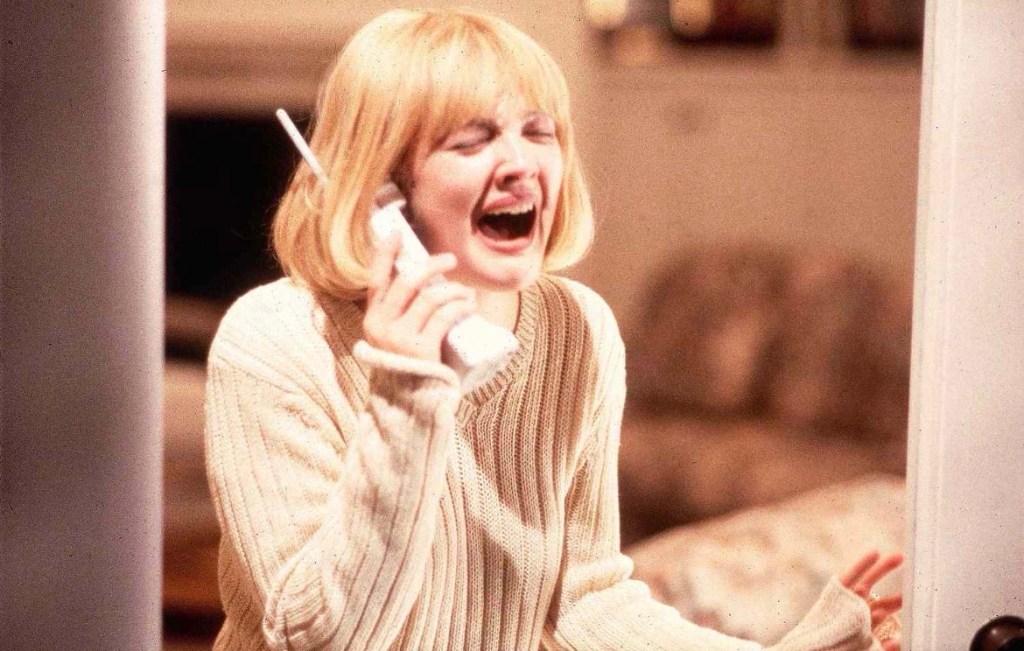
Drew Barrymore as Casey Becker in SCREAM 96’
 Michael's Jam
Leave a comment