Michael’s Jam
Every year, Super Bowl weekend sneaks up on me the same exciting way; suddenly everyone has big plans, opinions, and takes, even the ones who haven’t talked football since September. I notice how loud everything gets around the biggest game of the year—from texts, group chats, predictions, the music, the anticipation and how for a brief moment it feels like the entire country is paying attention to the same game again. It’s an incredible feeling and experience that all football lovers know what I’m talking about. Even if your team isn’t playing in the Super Bowl, people get together for parties, make bets and come together to celebrate the great sport of football.
That shared attention is rare now, and it’s why this weekend still carries weight for me beyond the final score. For a couple days, football becomes the main language again, pulling in diehards, casuals, skeptics, and even those insisting they’re only tuned in for the commercials but somehow know every storyline by kickoff. The Super Bowl still cuts through in a way almost nothing else does, and this year’s matchup feels especially clear once you strip away the noise.
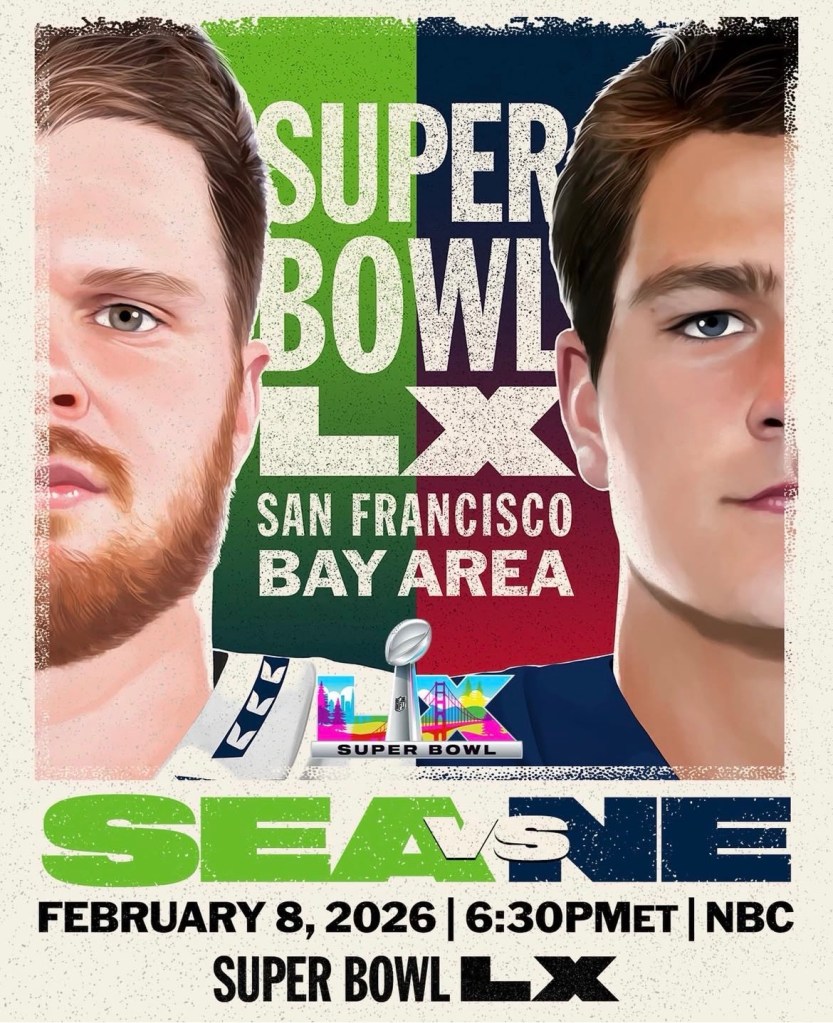
The Seattle Seahawks arrive as a team that knows exactly who it is, which is usually the biggest advantage on this stage. They aren’t chasing a moment or trying to prove relevance; they’re built around control, discipline, and patience, and that combination travels well in an environment that tends to overwhelm teams still figuring themselves out. The New England Patriots, meanwhile, feel like a franchise stepping into its future a year early, and while that’s thrilling, it’s also dangerous when the opponent across from you is already comfortable living in the present.
I expect Seattle to dictate this game in ways that don’t always explode on social media in real time, because dominance doesn’t have to be loud to be effective. It shows up in field position, in third downs that quietly flip momentum, in defensive pressure that speeds up decisions, and in an overall rhythm that slowly tilts the night in one direction. The Patriots’ young quarterback, Drake Maye, will have moments — talent doesn’t disappear under bright lights — but this feels like a game where experience, structure, and collective confidence eventually take over.
Offensively, Seattle doesn’t need to force anything to make a statement. Their ability to stay balanced, extend drives, and capitalize when opportunities present themselves is exactly how you separate in a Super Bowl without turning it into chaos. This is the kind of control that becomes obvious late, when one side still looks settled and the other starts chasing answers.
Halftime will do what halftime does now — dominate timelines, reset the room, and remind everyone that the Super Bowl lives just as comfortably in pop culture as it does in sports. With Bad Bunny headlining, the performance feels built for presence rather than gimmicks, the type of set designed to be felt more than dissected, and by the time the second half kicks off, the night will already have its own momentum. Bad Bunny thrives in the tension between pop superstardom and cultural provocation. His unapologetic political statements on immigration, refusal to dilute Spanish on global stages, and comfort stepping into gender-fluid fashion have made him a recurring target in the culture wars, with critics arguing his activism eclipses the music. At the same time, lawsuits, backlash over public behavior, and accusations of courting controversy rather than avoiding it have followed his rise. Yet that friction is the point: Bad Bunny doesn’t aim to be universally palatable—he forces the conversation, and pop culture keeps showing up to argue with him.
But the real story that sticks with me most sits under center for Seattle, because while much of the conversation around this game revolves around youth, projection, and what comes next, it’s Sam Darnold who represents something quieter and more interesting; patience paying off. He doesn’t chase the spotlight or rewrite his past out loud; he arrives here calm, sharp, and fully in command of an offense that trusts him.
And I’ll be clear about where I stand, because this isn’t a neutral take or a last-minute lean: I picked Seattle to win the Super Bowl back in November on DraftKings, long before Patriots fans started celebrating a gritty win over Denver like it was a coronation and long before Drake Maye hype turned into gospel. Beating the Broncos doesn’t suddenly make you inevitable, and potential doesn’t cash trophies, especially on this stage, against a team built to suffocate momentum and expose timelines. I’m riding with Seattle because they don’t need a storyline to feel relevant; they impose themselves, they control the night, and when the lights are brightest, they remind everyone there’s a difference between arriving early and actually being ready.
When the confetti falls, this Super Bowl won’t be remembered for chaos or miracles, but for clarity. The Seahawks don’t just win this game — they run it.
 Michael's Jam
Leave a comment